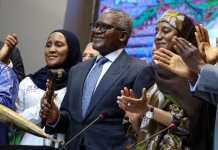
The Nigerian Education Loan Fund (NELFUND) has received an overwhelming 745,000 applications for its interest-free student loan scheme, with 2,700 of those applications submitted in the last 24 hours alone. According to NELFUND’s Managing Director/Chief Executive Officer, Akintunde Sawyerr, over 400,000 students are already benefiting from the loan, with their school fees paid at the tertiary level and some receiving N20,000 per month for upkeep.
NELFUND has disbursed over N80 billion to Nigerian institutions and beneficiaries of the loan. Sawyerr disclosed this at the two-day Renewed Hope Student Leaders’ Engagement, organized by the Office of the Senior Special Assistant to the President on Students’ Engagement in partnership with the Rivers State Government. The event was held at the University of Port Harcourt, highlighting the government’s commitment to education and youth development.
The law establishing NELFUND has been repealed and re-enacted to allow funding from non-governmental sources. This means philanthropists, general donors, NGOs, and individuals with a special interest in education can contribute to the fund, which will be used to provide loans or grants to students. This development is expected to increase the fund’s resources and benefit more students.
NELFUND’s loan scheme offers two categories of loans: institutional loans to cover tuition and upkeep loans for living expenses. Both types of loans are interest-free, with repayment starting two years after completion of the National Youth Service Corps (NYSC) program. Employers are statutorily required to deduct 10% from beneficiaries’ salaries once repayment begins. However, if a borrower loses their job before completing repayment, the payment stops. Self-employed individuals are required to remit 10% of their monthly profit to NELFUND.
The Senior Special Assistant to the President on Students’ Engagement, Asefon Dayo, noted that NELFUND has significantly reduced the rate of dropouts in tertiary institutions. Additionally, President Bola Ahmed Tinubu has approved funding for 15 colleges of education, polytechnics, and universities to establish innovation hubs and entrepreneurship centers. These centers will feature cutting-edge facilities, including robotics, artificial intelligence, 3D printing, and electronics labs, further enhancing the educational experience for Nigerian students.
The Renewed Hope Student Leaders’ Engagement serves as a platform to bridge the gap between the government and students. Dayo emphasized the importance of engaging student leaders meaningfully, informing them about the government’s reforms in education and youth development, and hearing their concerns directly. This initiative demonstrates the government’s commitment to listening to and supporting the needs of its young citizens.