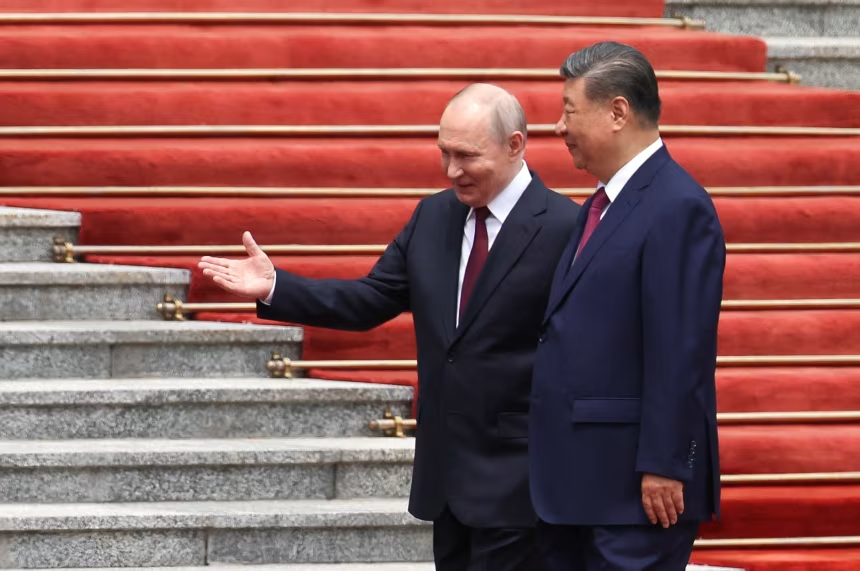
Beijing, May 2026 — Chinese President Xi Jinping welcomed Russian President Vladimir Putin with a lavish red-carpet ceremony in Beijing, underscoring the strength of their partnership and signaling a united front against U.S. influence. The meeting, marked by military honors and symbolic gestures, was more than diplomatic courtesy, it was a deliberate show of solidarity between two powers seeking to reshape the global order.
Putin’s arrival was his 25th official visit to China, a testament to the durability of the relationship. Xi praised the partnership as a “stabilizing force in a turbulent world,” while warning against “hegemonic currents” that threaten peace. Though he did not name the United States directly, the message was clear: Beijing and Moscow are positioning themselves as counterweights to Washington’s dominance.
China and Russia have long shared a complicated history, oscillating between rivalry and cooperation. Since the collapse of the Soviet Union, ties have steadily deepened, particularly after Western sanctions on Russia following its annexation of Crimea in 2014. The Ukraine war further accelerated Moscow’s pivot eastward, with Beijing emerging as a crucial economic lifeline. Today, the relationship is framed not just as pragmatic, but as strategic an alliance of necessity and ambition.
Trade between China and Russia has surged, reaching record highs in energy, defense, and technology. Russia has become one of China’s top oil and gas suppliers, while Chinese companies have stepped in to fill gaps left by Western firms. Joint infrastructure projects, from pipelines to railways, are reshaping Eurasian connectivity. Analysts note that sanctions have forced Russia to rely more heavily on China, while Beijing benefits from discounted energy and a loyal partner in its push for a multipolar world.
The red carpet, military parade, and warm personal gestures were carefully choreographed. Xi quoted Chinese proverbs about friendship, while Putin emphasized the “unprecedentedly high level” of relations. These symbolic flourishes were designed to project unity and mutual respect, contrasting with the more transactional tone of Xi’s recent meeting with U.S. President Donald Trump.

The two leaders signed a joint declaration pledging deeper cooperation in defense, energy, and technology. They criticized Trump’s proposed “Golden Dome” missile defense system, calling it destabilizing, and condemned U.S.-Israeli military actions against Iran. Xi urged an immediate ceasefire to protect global energy supplies, positioning China as a responsible stakeholder in global stability.
Western governments reacted cautiously. The U.S. State Department dismissed the summit as “symbolic posturing,” while European leaders expressed concern about the deepening China-Russia axis. In contrast, Chinese state media hailed the meeting as proof of Beijing’s growing role as a global powerbroker. Russian outlets emphasized the personal warmth between Xi and Putin, portraying the partnership as a bulwark against Western hostility.
In China, the visit was framed as evidence of Xi’s diplomatic skill and China’s rising stature. State television highlighted the pomp and ceremony, reinforcing the narrative of China as a global leader. In Russia, the partnership is seen as a lifeline amid isolation from the West, with public sentiment largely supportive of closer ties to Beijing.
The summit signals more than symbolic friendship. Joint projects in energy, infrastructure, and defense are expected to expand. Analysts predict greater military coordination, including joint exercises and technology sharing. The partnership could also influence conflicts in Ukraine and the Middle East, where both nations oppose U.S. intervention.
“China and Russia are not forming a formal alliance, but their cooperation is deepening in ways that challenge U.S. dominance,” said a senior fellow at the Carnegie Moscow Center. “This is about creating a multipolar world where Washington no longer sets the rules.” Another analyst noted, “Xi’s red carpet welcome was a message to both domestic and international audiences. At home, it reinforces his image as a global statesman. Abroad, it signals that China is willing to stand shoulder-to-shoulder with Russia against U.S. pressure.”
The Xi Putin summit highlights a growing axis aimed at counterbalancing U.S. power. By hosting Trump and Putin within days, Xi positions China as a mediator and global powerbroker. The joint statement signals a push for a multipolar world order, challenging decades of American dominance.