


Alan Greenspan, the former Federal Reserve chairman whose decisions shaped the trajectory of the U.S. and global economy for nearly two decades, died Sunday at his home in Washington at the age of 100, according to a statement from his family. His wife, journalist Andrea Mitchell, said he died from complications related to Parkinson’s disease. His death marks the end of an era in American economic policymaking. Few figures in modern history wielded as much influence over financial markets, interest rates, inflation strategy and global economic stability. Revered, criticized and endlessly analysed, Greenspan became synonymous with the rise of the modern American economy a period defined by rapid globalization, technological transformation and unprecedented financial integration. For nearly 20 years, Greenspan’s voice could move markets, his statements parsed with the intensity of scripture. Investors hung on his famously opaque phrasing, lawmakers sought his approval, and presidents across the political spectrum relied on his counsel. His tenure at the Federal Reserve from 1987 to 2006 made him one of the most consequential central bankers in world history.
Born in New York City in 1926, Greenspan grew up in a modest household in Washington Heights. A gifted student, he initially pursued music, studying clarinet and saxophone at Juilliard before turning toward economics. He earned his degrees from New York University and later completed a Ph.D. in economics. Before entering public service, Greenspan built a successful career as an economic consultant, advising corporations and political leaders. His analytical rigor and deep understanding of financial markets earned him national attention, eventually leading to his appointment as chairman of the Council of Economic Advisers under President Gerald Ford.
In 1987, President Ronald Reagan appointed Greenspan to succeed Paul Volcker as chairman of the Federal Reserve. Just months into his tenure, Greenspan faced his first major test: the October 1987 stock market crash, when the Dow Jones Industrial Average plunged 22 percent in a single day. Greenspan responded swiftly, issuing a now‑famous statement affirming the Fed’s readiness to provide liquidity to the financial system. The move helped stabilize markets and cemented his reputation as a steady hand in crisis. He went on to serve under four presidents Reagan, George H. W. Bush, Bill Clinton and George W. Bush navigating the central bank through some of the most transformative economic periods in modern history.

Greenspan presided over the long economic expansion of the 1990s, a decade marked by low inflation, rising productivity and the explosive growth of the technology sector. His cautious but flexible approach to interest rates helped sustain the boom, though he famously warned of “irrational exuberance” in 1996 as stock valuations soared. When the dot‑com bubble burst in 2000, Greenspan cut interest rates aggressively to cushion the economy. His actions helped limit the downturn but also fueled debates about whether the Fed had allowed asset bubbles to inflate unchecked.
During Greenspan’s tenure, globalization accelerated dramatically. Capital flowed across borders with unprecedented speed, emerging markets integrated into global supply chains, and financial innovation reshaped banking and investment. Greenspan championed free markets and minimal regulation, arguing that market forces were generally more efficient than government intervention. His critics later argued that this philosophy contributed to systemic vulnerabilities that surfaced during the 2008 global financial crisis.
Greenspan’s legacy is deeply intertwined with debates over the causes of the financial crisis. Many economists contend that the Fed’s low interest rates in the early 2000s contributed to the housing bubble. Others argue that his support for financial deregulation including the growth of complex derivatives weakened safeguards against systemic risk. Greenspan himself acknowledged in congressional testimony after the crisis that he had “found a flaw” in his belief that financial institutions would act in their own long‑term self‑interest. Still, supporters maintain that Greenspan delivered nearly two decades of economic stability, guiding the U.S. through multiple shocks with a steady, data‑driven approach.
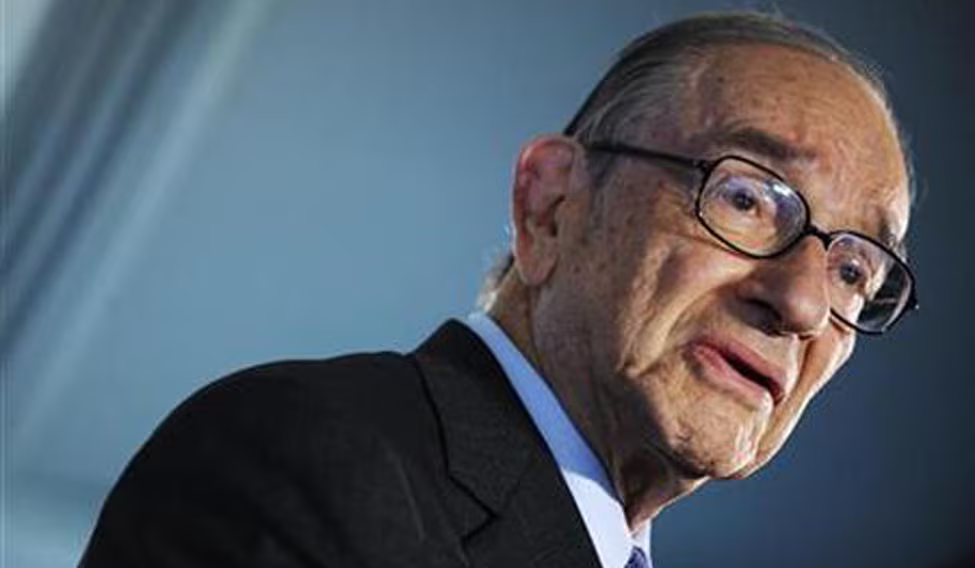
Tributes poured in from economists, political leaders and financial institutions. Federal Reserve Chair Jerome Powell called Greenspan “a towering figure whose intellectual discipline and commitment to price stability shaped the modern Federal Reserve.” Former Fed Chair Ben Bernanke said Greenspan “helped build the framework of modern central banking,” while Janet Yellen praised his “unmatched understanding of financial markets.” International leaders also weighed in. The European Central Bank said Greenspan’s influence “extended far beyond the United States,” shaping global monetary policy for a generation.
Greenspan’s tenure is often contrasted with that of his predecessor, Paul Volcker, who broke the back of inflation in the early 1980s. While Volcker was known for decisive, sometimes painful rate hikes, Greenspan became known for subtlety a maestro of market psychology. His successors Bernanke, Yellen and Powell inherited a world shaped by Greenspan’s policies, from inflation targeting to the Fed’s communication strategy. Many of today’s central banking norms trace their roots to his tenure.
Greenspan’s ideas continue to shape inflation management, interest‑rate policy, global financial integration, market‑based economic governance and central bank independence. His writings, speeches and policy decisions remain required reading for economists and historians. Alan Greenspan leaves behind a complex legacy one defined by extraordinary influence, intellectual rigor and deep controversy. He guided the U.S. economy through booms, busts, crises and transformations, helping shape the financial architecture of the modern world. History is likely to remember him as both a stabilizing force and a symbol of the risks inherent in financial liberalization. His achievements and missteps continue to shape debates about the role of central banks, the limits of markets and the responsibilities of policymakers. Greenspan’s death closes a chapter in global economic history, but the world he helped build interconnected, dynamic and vulnerable endures.


