WASHINGTON — President Donald Trump has ordered the Pentagon to substantially reduce U.S. participation in joint military exercises with South Korea, a decision that could reshape one of Washington’s most important security arrangements in East Asia.
Trump issued the directive Sunday, shortly before the annual Ulchi Freedom Shield exercises were due to begin. He said he was unhappy that the United States had agreed to participate in the drills, describing them as costly and arguing that they send an inappropriate and hostile message to North Korea.
Trump also pointed to his relationship with North Korean leader Kim Jong Un as a reason for opposing the scale of the exercises. He said his administration had maintained a good relationship with Kim and questioned the need for military activities that Pyongyang has consistently regarded as preparations for war.
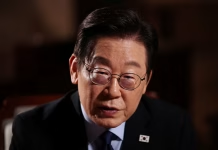
The president additionally expressed frustration with South Korea over its decision not to participate in U.S. efforts linked to Iran. According to Trump’s remarks, he had asked South Korean President Lee Jae Myung whether Seoul would support U.S. efforts aimed at the denuclearization of Iran, but South Korea declined.

Despite Trump’s order, South Korea’s Defense Ministry said the exercises would proceed as previously scheduled. The drills, known as Ulchi Freedom Shield, are designed to strengthen the allies’ ability to respond to a potential North Korean attack and improve coordination between their forces.
The exercises involve about 18,000 South Korean troops, along with U.S. forces and personnel from other countries connected to the U.N. Command. The annual training has become a central part of the military alliance between Washington and Seoul, particularly as North Korea continues to expand its missile and nuclear capabilities.
The latest decision also comes at a sensitive moment on the Korean Peninsula. North Korea recently launched ballistic missiles and has strongly condemned the joint exercises, calling them provocative. Pyongyang has repeatedly used U.S.-South Korean military drills as justification for heightened military activity.
Trump’s approach has echoes of his first presidency, when he criticized some U.S. South Korean military exercises as expensive and provocative following his 2018 summit with Kim Jong Un in Singapore. That period saw several large scale exercises suspended or reduced as Washington pursued direct diplomacy with Pyongyang.

The new order is likely to generate debate among U.S. and South Korean security officials over military readiness and deterrence. Supporters of reducing the exercises may view the move as an opportunity to lower tensions and create room for diplomacy, while critics could argue that scaling them back risks weakening the allies’ preparedness at a time of growing security challenges.
For South Korea, the issue also touches on the broader question of how firmly the United States intends to maintain its military commitment to the region. The two countries have maintained a formal defense alliance for decades, with tens of thousands of U.S. troops stationed in South Korea as part of efforts to deter North Korean aggression.
For now, the exercises are continuing, but Trump’s intervention has placed renewed attention on the future of the U.S. South Korea military partnership and his administration’s strategy toward Kim Jong Un’s government.