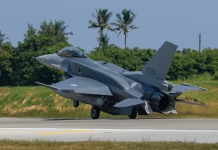
A routine Vietnam Airlines flight from Munich to Hanoi turned into a tense emergency on Aug. 15 when the Boeing 787 to 9 struggled to gain speed during takeoff and eventually lifted off just before reaching the end of the runway.
Flight VN34 was carrying 271 passengers and 16 crew members when the problem developed on runway 26L at Munich Airport. Everyone on board survived, and no injuries were reported.
According to preliminary findings, the pilots noticed that the aircraft’s speed stopped increasing for about two seconds while the plane was accelerating down the runway. The aircraft then picked up speed again before losing speed for a second time.
By then, the plane had reached a critical point in the takeoff. The pilots determined that there was not enough runway left to safely stop the aircraft, so they continued the takeoff and applied maximum thrust.
The aircraft managed to get airborne extremely close to the end of the runway. In the process, the rear underside of the Boeing 787 struck the runway, causing a tail strike.
The aircraft also reported warnings indicating that tire pressure had been lost. A later inspection found that four tires had burst, including three on the left main landing gear and one on the right.

Instead of continuing to Hanoi, the pilots decided to return to Munich. The aircraft remained in the air for about two hours while fuel was released to reduce its weight for landing.
The crew also flew two low altitude circuits around the airport, allowing air traffic controllers to assess the condition of the aircraft’s landing gear before the pilots attempted to land.
The Boeing eventually touched down safely on another runway at Munich Airport. Passengers were taken off the aircraft using stairs, and there were no reports of fire or smoke.
Video footage of the incident has since drawn attention online, showing the aircraft lifting off near the end of the runway. The footage gives a dramatic impression of how close the aircraft came to running out of available runway during the takeoff.
Despite the frightening sequence of events, investigators have not yet established exactly why the aircraft stopped accelerating normally. The preliminary findings describe what happened but do not provide a final explanation for the technical problem.
That distinction is important. Investigators have not concluded that the engines, pilots, maintenance work, runway conditions or any other particular factor caused the incident.

The crew’s decision to continue the takeoff also reflects one of the most important moments in commercial aviation. Once an aircraft passes its designated decision speed, known as V1, stopping may no longer be the safest option. Pilots are trained to continue the takeoff and deal with the problem in the air when there is insufficient runway remaining.
For the people on board VN34, the experience was undoubtedly frightening. What began as a normal international flight suddenly required the pilots to make several critical decisions before eventually bringing everyone safely back to Munich.
The aircraft has been grounded as investigators continue examining the incident. Their findings will be important in determining what caused the unusual loss of acceleration and whether any wider safety lessons need to be addressed.
For now, the most reassuring part of the story is also the simplest: despite the damaged tires, tail strike and difficult takeoff, all 287 people aboard the Vietnam Airlines aircraft returned safely to the ground.