FFIRI confirms national team will compete in the United States, Mexico, and Canada only if its concerns are addressed, raising new challenges for FIFA.
Iran’s football federation has confirmed that its national team will take part in the 2026 FIFA World Cup, but only under a series of conditions that could complicate preparations for the tournament.
After weeks of speculation surrounding Iran’s status, the Football Federation Islamic Republic of Iran (FFIRI) announced Saturday that the team will compete in the tournament, scheduled from June 11 to July 19 across the United States, Mexico, and Canada. “We will definitely participate in the 2026 World Cup, but the hosts must take our concerns into account,” the federation declared in a statement.
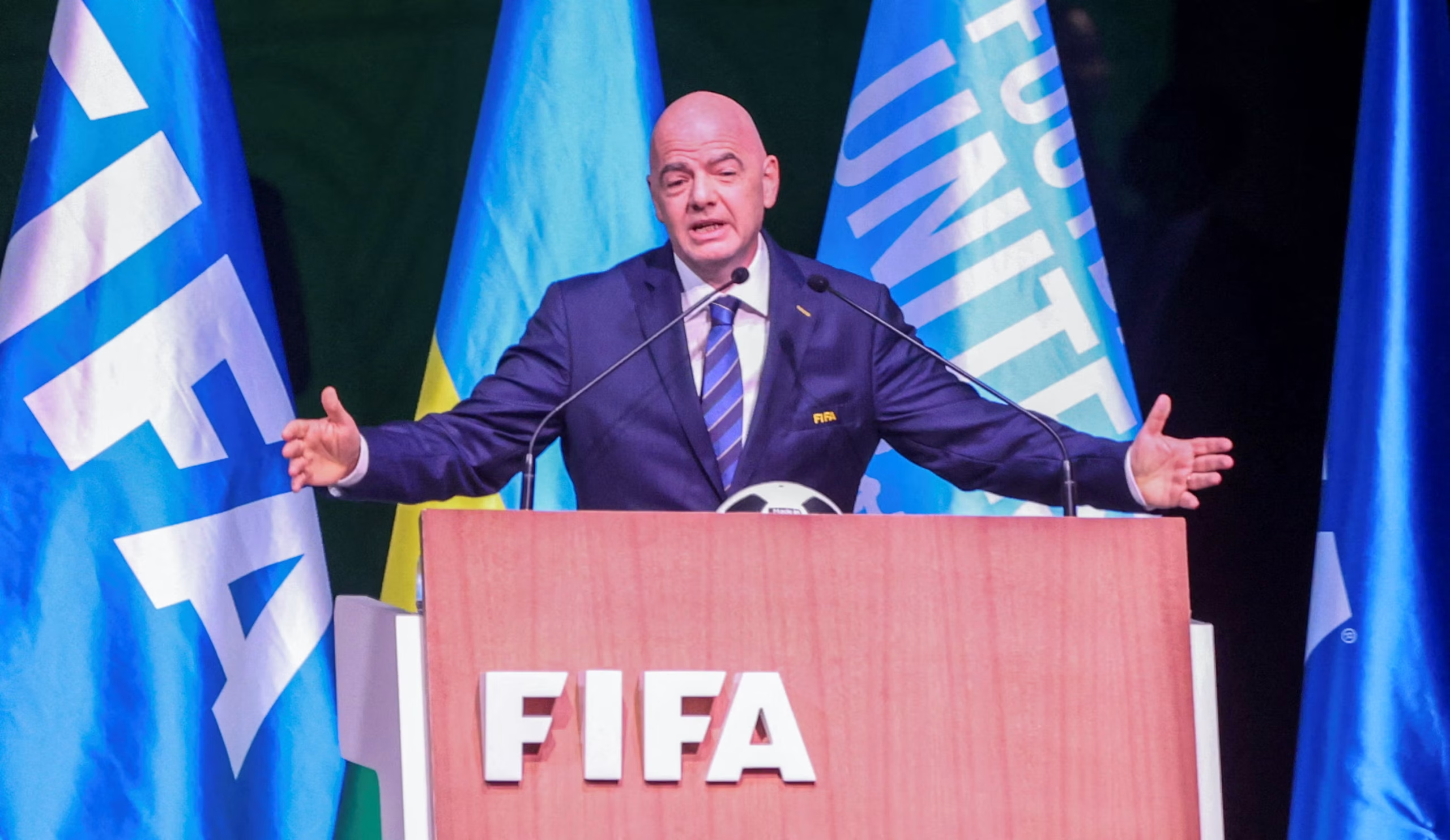
The announcement comes as FIFA President Gianni Infantino continues to promote the World Cup as a global celebration. Instead, he now faces a fresh crisis, with Iran insisting that its participation depends on assurances covering visas, security, cultural respect, and fair treatment. According to sources familiar with the negotiations, the federation has asked for guarantees that players, staff, and fans will be able to travel freely, that they will be protected from discrimination, and that their cultural practices including dress codes and dietary requirements will be respected. Iran has also raised concerns about politically sensitive fixtures, requesting neutral venues in certain cases, and has sought assurances that its matches will be broadcast fairly without censorship or restrictions.

Diplomatic tensions between Iran and the host nations have long raised questions about visas, travel restrictions, and political sensitivities. Analysts say Iran’s stance highlights how global politics and football are increasingly intertwined. “This is unprecedented a qualified team setting conditions for participation,” said a Middle East sports analyst. “It shows how the World Cup is not just about sport but also about diplomacy.”
Fans in Iran expressed mixed feelings, with some supporting the federation’s emphasis on sovereignty and respect, while others worry the demands could jeopardize the team’s place in the competition.
Iran’s participation in the World Cup has often been shaped by politics. In 1998, the team faced the United States in Lyon, France, in one of the most politically charged matches in tournament history. FIFA had to carefully manage the optics, with both teams exchanging flowers before kickoff to ease tensions.
In 2022, Iran’s squad in Qatar drew global attention amid domestic protests following the death of Mahsa Amini, with players facing scrutiny over whether they would sing the national anthem. That tournament highlighted how Iran’s football often reflects broader political struggles at home.
Earlier precedents also exist outside Iran. South Africa was banned from FIFA competitions during the apartheid era until 1992, and several nations boycotted the 1974 World Cup qualifiers over political disputes. These examples show how global politics have repeatedly intersected with football.
For FIFA, the challenge lies in balancing inclusivity with host nation policies. The 2026 World Cup, the first to feature 48 teams, is already a logistical undertaking across three countries. Iran’s conditional participation adds another layer of complexity, underscoring the delicate intersection of sport, politics, and global diplomacy.